🥛 Dairy Protein · ≥88% · Heat-Stable · EU Food Grade
Sodium Caseinate — The Emulsifier Protein
The industry's go-to protein for emulsification, heat stability and feathering resistance. ≥300 mL oil/g emulsification capacity, stable to 140°C, <0.1% lactose. B2B wholesale from Warsaw — min. 25 kg, 27 EU countries.
All key parameters for QA and formulation qualification. Highlighted values represent sodium caseinate's standout properties. Full CoA available before order.
Two interactive charts: functional property radar across 5 protein sources, and pH-dependent solubility curve — the critical guide for beverage formulation.
Functional Properties Radar
Emulsification, heat stability, solubility, foaming, gelation, water binding and whitening — 5 protein sources compared on a 0–100 scale.
Scale 0–100, relative functional capacity under standard food processing conditions. Source: compiled literature + FDCM specification data.
pH Solubility Curve
Protein solubility (%) vs pH — critical for beverage, sauce and acidic food formulation decisions. Note isoelectric point at pH 4.6.
Solubility % at 20°C, ionic strength 0.1M NaCl. Isoelectric point of sodium caseinate ≈ pH 4.6 — minimum solubility. Above pH 5.5, rapid solubility recovery.
🧮 Formulation Tool
Emulsification Dose Calculator
Select your application and batch size — get recommended sodium caseinate dosage, batch quantity and emulsification capacity estimate.
Input Parameters
Select application and batch size to calculate recommended inclusion.
Estimates based on typical application dose ranges. Actual optimal inclusion depends on specific formulation, process parameters and desired functionality. Always conduct pilot trials.
🏭 Application Guide
Sodium Caseinate by Application
Deep formulation guidance for five key application segments — mechanism, dose, formulation protocol and the unique advantage sodium caseinate provides in each.
📊 Competitive Intelligence
Protein Source Comparison — Sortable
Click any column header to sort. Compare sodium caseinate to 7 other commercial protein sources across 9 key parameters — protein content, DIAAS, solubility, heat stability, emulsification, allergen, lactose and cost index.
Protein source
Protein %
PDCAAS
DIAAS
Solubility pH7
Heat stability
Emulsification
Allergen
Lactose
Click column headers to sort. FDCM row highlighted. Cost index is relative (Sodium Caseinate = 100). Source: FDCM specs + published literature.
🔍 FDCM Catalogue
Search All 27 FDCM Ingredients
Find complementary ingredients, related caseins, proteins and functional ingredients — all link directly to fdcm.eu.
DSV road freight All 27 EU member states Incoterms DAP 2–5 business days Min. order: 25 kg
❓ FAQ
Frequently Asked Questions
Technical, functional, regulatory and commercial questions — formulator-level depth on sodium caseinate chemistry and applications.
Sodium caseinate is produced by acid precipitation of casein from skimmed milk at its isoelectric point (pH 4.6), followed by neutralisation with sodium hydroxide (NaOH) to form a soluble sodium salt. The result is a highly functional protein with ≥88% protein content (db), ≤0.1% lactose, and excellent solubility above pH 5.5. Unlike micellar casein (which retains its native micelle structure) or acid casein (the insoluble intermediate), sodium caseinate is a dispersed, non-micellar form with superior emulsification and solubility properties.
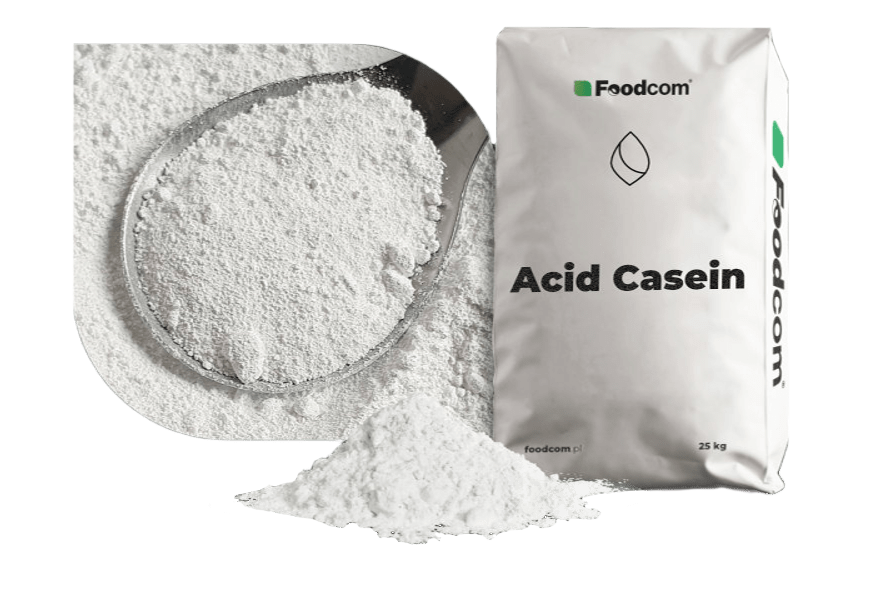
All four are casein protein forms derived from milk: (1) Acid casein — precipitated at pH 4.6, not soluble, requires further processing; (2) Sodium caseinate — acid casein neutralised with NaOH → fully soluble, excellent emulsifier; (3) Rennet casein — precipitated by rennin enzyme (not acid), contains calcium, used for cheese analogues requiring melt and stretch; (4) Micellar casein (MPC/MCC) — produced by membrane filtration, retains native micelle structure, slow-release characteristics. For emulsification, heat stability and clean protein fortification: sodium caseinate is the preferred form.
Sodium caseinate has exceptional emulsification capacity of ≥300 mL oil per gram of protein — significantly higher than whey protein isolate (~150 mL/g), soy protein isolate (~200 mL/g) or pea protein (~100 mL/g). The mechanism: casein monomers (αs1, αs2, β, κ) are highly amphiphilic with distinct hydrophobic and hydrophilic domains. They adsorb spontaneously to oil-water interfaces, forming a viscoelastic film that prevents droplet coalescence. This property makes sodium caseinate irreplaceable in coffee whiteners, cream liqueurs and emulsified sausage.
'Feathering' in coffee occurs when protein aggregates at low pH (coffee pH 4.5–5.5) and high temperature combine with divalent cations (Ca²⁺, Mg²⁺) to cause bridging flocculation. Sodium caseinate resists this because: (1) Its phosphoserine clusters (SerP) sequester Ca²⁺ ions, preventing cross-linking; (2) The κ-casein fraction provides steric stabilisation through a glycomacropeptide 'brush layer' on emulsion droplets; (3) Sodium ions from the sodium salt form compete with Ca²⁺ for casein binding sites. Plant proteins and whey proteins lack this combination — making sodium caseinate the industry standard for hot coffee beverage whiteners.
Sodium caseinate is exceptionally heat-stable compared to other proteins. It does not denature in the classical sense (no ordered secondary structure to unfold) — instead, it undergoes gradual aggregation at very high temperatures. Stability: stable to 140°C for UHT processing; stable to 121°C retort sterilisation at pH >6; stable to Maillard reaction up to 160°C due to very low lactose (<0.1%). Compare to whey protein: denaturation begins at 72°C, significant aggregation at 85°C. This makes sodium caseinate the protein of choice for high-temperature processed dairy analogues, cooked meat systems and UHT protein beverages.
Optimal hydration protocol: (1) Add powder to cold or warm water (20–50°C) with vigorous agitation — avoid >70°C during initial dispersion to prevent surface denaturation; (2) Hydration time: 15–30 min for full hydration at 5% concentration; (3) At >8% concentration, use high-shear mixer (rotor-stator) to prevent lump formation; (4) pH adjustment: for acidic systems (pH <5.5), dissolve at neutral pH first, then acidify slowly under continuous stirring; (5) Avoid direct contact with concentrated acid or calcium salts during dispersion — add these after initial hydration.
Sodium caseinate contains approximately 1.2–1.5% sodium (Na) — corresponding to ~3.0–3.75% salt equivalent per 100g of powder. In finished food products at typical usage levels (2–4%), sodium contribution is: ~2g product × 1.3% Na = 26 mg Na per 100g finished product. For low-sodium formulations, calcium caseinate (Ca²⁺ neutralised) is an alternative — but it has lower solubility. Under EU Regulation 1169/2011, sodium content must be declared in nutrition labelling per 100g and per serving.
This is a complex regulatory question. In EU law: sodium caseinate is derived from milk and is a milk protein — it MUST be declared as 'contains milk' under Regulation (EU) 1169/2011 Annex II (milk is a mandatory allergen). The term 'dairy-free' is not legally defined in EU law, but the milk allergen declaration overrides any 'dairy-free' claim. However, in some jurisdictions and product categories, 'non-dairy' specifically refers to absence of lactose (≤0.02 g/100g) — sodium caseinate meets this criterion with <0.1% lactose. Always include mandatory milk allergen declaration regardless of product positioning.
Sodium caseinate solubility profile: Below pH 4.0: <15% solubility — heavily aggregated; pH 4.0–5.0: minimum solubility near isoelectric point (pI ≈ 4.6) — forms a viscous gel/precipitate; pH 5.0–5.5: rapid solubility recovery, 40–75%; pH 5.5–6.0: 75–90% soluble; pH 6.0–8.0: ≥95% fully soluble. Key formulation implication: for acid beverages (pH <4.5), special techniques are needed: heat treatment before acidification, use of pectin + CMC stabiliser system, or switch to acid-stable casein hydrolysate.
Every delivery includes: Certificate of Analysis (CoA) with protein content (Kjeldahl), moisture, fat, ash, lactose, pH, solubility, viscosity, microbiological results (TPC, coliforms, Salmonella, Listeria), heavy metals; Safety Data Sheet (SDS); Technical Data Sheet (TDS); Allergen Statement — mandatory milk allergen declaration; Non-GMO Declaration; HACCP and food safety certification reference. CoA available before order for supplier qualification. Typical CoA turnaround: same batch as delivery. Contact: contact@fdcm.eu — we respond within 4 business hours.
Minimum order: 1 bag (25 kg) — no volume commitment required. Pallet quantities (600 kg, 24 bags) with preferential pricing for regular supply. Lead time: 2–5 business days for Western/Central EU via DSV road freight from Warsaw, Poland. Incoterms DAP — delivered to your facility. All documentation included. Contact: contact@fdcm.eu
Gastric emptying rate: sodium caseinate 2–4 g protein/hour; whey protein 8–10 g protein/hour. Mechanism: at stomach pH (<3), caseinate forms a gel/clot that resists pepsin digestion, releasing amino acids gradually over 4–7 hours. Whey protein remains soluble and passes rapidly. Clinical implications: (1) Pre-sleep: caseinate maintains positive nitrogen balance during overnight fast (Res et al., 2012 — 40g caseinate pre-sleep improved muscle mass); (2) Satiety: caseinate releases CCK and PYY more sustained than whey, improving satiety for 4–5h; (3) MPS: whey is superior for acute post-exercise MPS; caseinate superior for overnight protein balance. Optimal strategy: whey post-workout + caseinate before sleep.